New Book Announcement

Years ago, when I first really learned about catechisms, I went out looking for one to use with my kids, but I couldn’t find the right one. While I certainly appreciate the appeal of the historic catechisms and their wording, I wanted something a little more “down to earth.” Think the living room, not the formal dining room. So I wrote one.

Fast forward to now when my kids are 19, 17, and 13. After seeing first hand the value of catechising in the home, I am thrilled that InterVarsity Press has trusted me to produce a new family discipleship resource based on a 99-question Family Catechism. Faith Foundations will release in October 2025, but it is already available for pre-order. I hope and pray this book helps your family as much as using a catechism helped mine!

Here’s the marketing copy from my friends at IVP:

Staying in Our Lane

TLDR: Neither in ministry nor in life are we expected to be omnicompetent. We simply lack the training, experience, and skills for that. Rather, it is better that we embrace our limits and thrive in the often narrower lane God has placed us in.

I recently saw a kidmin leader reach out to a group of other kidmin leaders for advice; a parent had recently approached her for help concerning her child who was just diagnosed with ADHD. This kidmin leader has heard negative things about putting kids on meds and was looking for any input on what other options she could share with this parent.

A Quick Detour

I also recently saw a social media post where a Tesla driver was asking the car maker about adjusting the car’s programming to center the car in the lane more. Apparently, he and other drivers have experienced their self-driving cars hugging one of the lane lines instead of staying in the middle of the lane. First-world problems, right? But I found it fascinating because I tend to find everything involving self-driving cars fascinating. (One of these days, I’m going to get one of those things and really decrease my rush hour stress.) The programming and technology involved in these cars is amazing. But they still have bugs to work out. Driving in a lane isn’t good enough; it’s best to drive more in the center of the lane. Which takes us back to where we began.

We Are Not Omnicompentent

I’m sure this kidmin leader looking for guidance means well, but it’s surely concerning. Medicine and ADHD treatments are well out of the scope of most kidmin leaders, indeed, most of us in general, unless you are a physician, a therapist, or some other related specialist. And here’s the double-edged sword we must be aware of: It’s a good thing when families come to kidmin leaders for help, but we cannot make the mistake of positioning ourselves or allowing families to see us as omnicompetent.

We aren’t. We were never meant to be.

Our specialty—our focus—must remain on the gospel. When families need help with the gospel, we should be there. That’s our calling and that’s our gift to our families and the church. But when we are asked for help beyond that, we should be quick to clarify our limitations and instead help them find what they need from elsewhere. In this case, being sure that this mother is working with her doctor is a top priority. And then beyond that, depending on the situation, a licensed therapist could be called on as well. Can and should we pray with this mother? By all means! Can and should we provide counseling about her child being an image bearer beloved by God and created by Him? By all means! So, we don’t abdicate everything in a situation like this. Rather, we hold onto what is in our “lane” and we refer the rest.

Our Limits Are a Gift

We need to be honest: This can be hard. It feels good when others see us as an expert, or a wise sage in all areas of life. But we need to resist giving in to that for three reasons.

First, it’s what’s best for the other person. If we want the best for those we serve—and we surely do—then we should have no qualm about pointing them to get the best help and support they can get, and that support will often not be us. Let’s love our people enough to point them to others when needed.

Second, it’s best for us. It’s weighty enough to partner with parents to disciple children and help those parents disciple their children. Why would we ever want to add further weight to that? Lighten your load and cast off areas you were never meant to carry!

Third, it’s good for the gospel. God’s design of the church is for us to need one another. We are all to recognize our limits. None of us are enough; only Jesus is. When we are quick to acknowledge our limits and turn to others, we picture the gospel.

Joseph and His Brothers Reunite

TLDR: A guide for having a family discipleship time on Genesis 42–45; 50: based on the ACT Bible Study Method.


Act 3: God Promises Jesus
Scene 24: Joseph and His Brothers Reunite
Genesis 42:1—45:28; 50:15–21

Analyze the Passage

Step 1: Introduce the Passage

Genesis was written by Moses sometime between 1445–1405 BC to help the Israelites leaving Egypt understand their history with God. It’s one of the five books of the Law that Moses wrote, which we also call the Torah, or the Pentateuch, which means “five books.”

Today’s true story is the finish to Joseph’s story. It’s a long story with a few twists and turns, and we won’t look at it all, but in the end it leads to a wonderful conclusion for someone who endured so much hardship, but who was able to see that God used it all for his good and God’s glory. This story is in Act 3: God Promises Jesus.

Step 2: Read the Passage

Genesis 42:1—45:28; 50:15–21

Step 3: Summarize the Passage

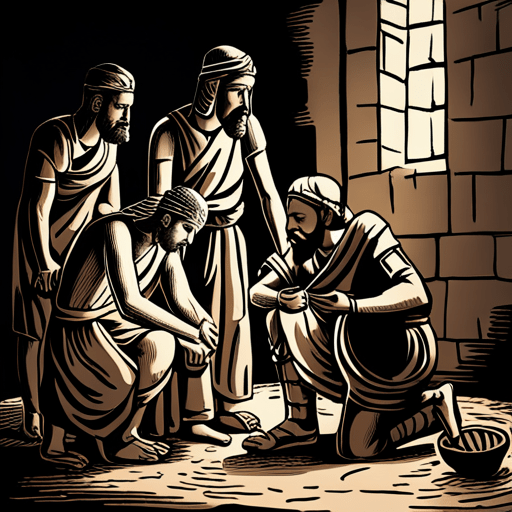
When Jacob learned Egypt had grain during the famine, he sent his ten sons, without Benjamin, who he was afraid to lose.

When Joseph saw his brothers he recognized them but pretended not to know them and spoke harshly to them. He accused them of being spies. The brothers said they were ten of twelve brothers from Canaan and they left the youngest home.

Joseph responded that they were spies and they had to stay until one brother left and brought the youngest brother with him. He imprisoned them for three days. Then, he told them that one brother had to remain and the rest would go bring the youngest brother back.

The brothers believed they were being punished for what they had done to Joseph, but they didn’t know it was Joseph who imprisoned them. Simeon was left behind.

Joseph had their sacks full of grain and their money placed back with it. He also had them given supplies for their trip. When on the way home the brothers learned they had been given back their money, they were afraid.

They returned and told Jacob all that had happened. But Jacob was distressed, believing Joseph was gone, now Simeon was gone, and if they took Benjamin, he’d be gone too. So, he refused.

When their grain ran out, Jacob told Reuben to go buy food. But he reminded him that they couldn’t return without Benjamin. Jacob told them to take gifts to give and double the money so they could give back what they had tried to give the first time.

When they got to Egypt, Joseph had a meal prepared for the brothers. When they came into Joseph’s house, they were afraid and tried to give the money from the first time to Joseph’s main servant. But the servant said everything was fine and brought them Simeon.

When Joseph arrived, they gave the gifts and he asked how their father was. When Joseph saw Benjamin, he hurried out and and went to his room and wept.

Then, he washed his face and returned. The brothers were seated in birth order, which amazed them. Benjamin was given a portion five times larger than the others. And they all drank together.

When it came time for them to leave, Joseph had food and the money placed in their sacks again. But he also instructed for his cup to be put in Benjamin’s. After they left, Joseph had his servants chase after them and ask them why they had done wrong to him by taking his cup.

The brothers denied taking the cup and said if anyone had it, he should die and the rest become Joseph’s slaves. The servant responded that if one has the cup, he would become a slave and the rest would go free.

The sacks were searched from the oldest to the youngest, and the cup was indeed found in Benjamin’s. The brothers then tore their clothes in grief, and they all returned to Joseph’s city.

Joseph asked them why they had done this, and Judah told him that they all were now his slaves. Joseph said that only the one who tool the cup would be. But Judah explained that their elderly father loves Benjamin and that his brother was dead. Judah then told Joseph about them coming and that if they returned without Benjamin, their father would die. Instead, Judah asked that Joseph keep him and let Benjamin return to spare their father such pain.

At this, Joseph could not control himself any longer. He commanded his servants to leave and then he wept loudly and told his brothers who he was. His brothers couldn’t believe it at first. But Joseph told them not to be upset or angry with what they had done so long ago. For God used that to save their lives. Joseph knew it was ultimately God who sent him to Egypt.

Joseph then told the brothers to go to their father and tell them what happened. And then to bring him back and they would live in Egypt. There. Joseph would provide for them for the five remaining years of famine.

Joseph wept with his brothers and he kissed them. And they talked together.

When Pharaoh learned what happened, he told Joseph to have his family move to Egypt and he’d give them the best of the land. So, the brothers left, after Joseph told them not to be afraid.

When the brothers told Jacob that Joseph was alive, he was stunned. Then he said he would go see Joseph before he died.

The family returned to Egypt and reunited with Joseph. Then, in time, Jacob did die. But when that happened, the brothers became afraid, worried that Joseph had bore a grudge against them and would repay them now. So they sent word to Joseph that before Jacob died, he had given instructions for Joseph to forgive his brothers for their sin. Then, they went and fell at Joseph’s feet.

Joseph told them not to be afraid. What they meant as harm, God used for good. Then Joseph comforted them.

Step 4: Interrogate the Passage

Questions you and your family ask might include:

  • Why did Joseph pretend to be a stranger?
  • Why didn’t the brothers recognize Joseph?
  • Why did Joseph speak harshly to them and accuse them of being spies?
  • Why did Joseph test them by having them bring Benjamin?
  • Why did Joseph change from one brother going while the rest remained prisoners to one brother staying?
  • Why was Simeon chosen to stay?
  • Why did Joseph give their money back?
  • Did Joseph’s household servant believe in God, the way he explained that God had given them their money back?
  • Why did Joseph seat the brothers by age?
  • Why did Benjamin get a larger portion of the meal?
  • Why did Joseph have his cup put in Benjamin’s sack?
  • Why was Joseph unable to control himself any longer after Judah asked to stay in Benjamin’s place?
  • Why did Joseph tell the brothers not to be overcome by fear as they left?
  • Did Jacob really give the final instructions to Joseph or did the brothers make that up?
Step 5: Wonder about the Passage

Wonder statements you and your family make might include:

  • I wonder if the ten brothers felt bitterness toward Benjamin for being the favorite, like they had toward Joseph.
  • I wonder if Joseph had a plan from the beginning of all that he would do with his brothers.
  • I wonder why the brothers connected what was happening to them to what they did to Joseph.
  • I wonder how Simeon felt being left as a prisoner all that time.
  • I wonder how Joseph had Simeon treated during that time.
  • I wonder what the reunion with Simeon was like.
  • I wonder why Joseph cried when he saw Benjamin, but he didn’t earlier when he had seen his other brothers.
  • I wonder how the brothers felt when they learned it was Joseph.
  • I wonder what Joseph and his brothers talked about.

Connect the Passage to Christ

Step 6: Find the World in Front of Text

In the middle of a story filled with reminders of how the world is broken by sin, today’s story gives us a glimpse of how God wants us to live. It seems that Joseph wanted to test his brothers, to see if they had changed over the years, and they showed that they had. Before, they wanted to kill a favored son; now they were willing to sacrifice themselves for one.

But even before they could prove themselves to Joseph, we see signs of the amazing level of love and forgiveness he showed to them. He could have had them thrown in prison immediately. He could have had them killed. But he didn’t. He gave them back their money—a sign of his love for them—and treated them well. Then, when he finally revealed himself to them, he was clear that he forgave them and understood that God used what they had done for good. He did not back away from calling what they had done wrong and evil, but he accepted it as a path to God preserving their lives.

In this way, we see an example of the love and forgiveness we should extend to others. People will wrong us in big ways and small ways. God wants us to reject anger and bitterness and revenge and hold onto love and forgiveness. There is a time and place for justice, for sure, but our primary concern should be to love others who wrong us to show them Jesus’ love and to forgiven them, whether they deserve it or not.

Step 7: Find the World of Jesus of the Text

Joseph’s love and forgiveness is impressive, but it is nothing compared to the love and forgiveness of Jesus. In fact, the story of Joseph points us to Jesus. Each was a beloved son betrayed by his family. Each endured great hardships even though they were innocent. And each brought life from their hardships—Joseph physical life in a famine and Jesus spiritual life because of sin. Jesus is the greater Joseph, bringing life and restoring a shattered family through his sacrifice, his love, and the forgiveness he provides.


Translate It to Your Context

Step 8: Connect the World of Jesus of the Text to Your World

Who do you need to forgive? Who has wronged you in a big way or a small way that you can truly forgive? How can you let that person know they are forgiven? Who might you ask to forgive you for something you’ve done wrong?

Who can you show the love of Jesus to this week? What are some ways you can love your family, friends, neighbors, and even strangers with the amazing and powerful love of Jesus?


This will wrap up this walk through Genesis using the ACT Bible Study Method, at least for now. I hope it has given you an idea of how to use this method in the home and encouraged you to give it a try!

Learn more about this family discipleship method here.

Joseph in the Palace

TLDR: A guide for having a family discipleship time on Genesis 41 based on the ACT Bible Study Method.


Act 3: God Promises Jesus
Scene 23: Joseph in the Palace
Genesis 41:1–57

Analyze the Passage

Step 1: Introduce the Passage

Genesis was written by Moses sometime between 1445–1405 BC to help the Israelites leaving Egypt understand their history with God. It’s one of the five books of the Law that Moses wrote, which we also call the Torah, or the Pentateuch, which means “five books.”

Today’s true story is a turning point in Joseph’s story. After so much wrong that was done to him, he goes from the prison to the palace to become Pharaoh’s second in command. It’s an amazing rise from as low as one can go to so far high up in one of the most powerful countries in the world at the time. And it was all God’s doing. This story is in Act 3: God Promises Jesus.

Step 2: Read the Passage

Genesis 41:1–57

Step 3: Summarize the Passage

Two years after the cupbearer’s dream, Pharaoh had one. He was standing by the Nile and saw seven good cows. Then he saw seven skinny, bad cows. The bad cows ate the good ones.

Pharaoh then had a second dream. There were seven healthy heads of grain and seven unhealthy ones. The unhealthy ones swallowed the healthy ones.

In the morning, Pharaoh called all his diviners and wise men but no one could tell him what his dreams meant. Then the cupbearer remembered Joseph. He told Pharaoh what had happened with Joseph and Pharaoh called for Joseph.

Joseph was released from prison and cleaned up. Pharaoh said he heard Joseph could interpret dreams, but Joseph said it was not him, but God who could. So, Pharaoh told Joseph about his dreams.

Then Joseph explained that God is showing Pharaoh what he is about to do. Both dreams mean the same. Seven good years were coming that would be followed by seven years of famine, a famine that would devastate the land.

Joseph then continued by making a suggestion that Pharaoh should appoint a wise man to appoint officials to collect 1/5 of the produce for the seven good years and store this grain. This would then provide food for the seven years of famine.

This made sense to Pharaoh, so he appointed Joseph as that leader. Joseph would be second only to Pharaoh.

Pharaoh put his ring on Joseph’s finger and clothed him with fine clothing. Then the people kneeled before Joseph. Joseph was given a wife too.

All this happened when Joseph was 30 years old. And Joseph did as he had suggested, saving up grain for seven years.

Joseph had two sons before the famine. Both of their names revealed that Joseph had forgotten all his troubles and recognized God had blessed him.

Then, the famine came and Joseph used the store grain to feed the people. And people from outside of Egypt came there to buy grain too.

Step 4: Interrogate the Passage

Questions you and your family ask might include:

  • Was Joseph asked for advice after interpreting the dreams or did he offer that on his own?
  • Was it uncommon for a non-Egyptian to be placed into such a high position?
Step 5: Wonder about the Passage

Wonder statements you and your family make might include:

  • I wonder how badly the cupbearer felt at having forgotten Joseph.
  • I wonder if Joseph was nervous or afraid before Pharaoh.
  • I wonder if Joseph’s advice was given hoping Pharaoh would make him that leader.
  • I wonder what it was like for Joseph to go from the prison to second in command in one day.

Connect the Passage to Christ

Step 6: Find the World in Front of Text

Once again, the larger story around Joseph reminds us of how the world is broken. Imprisonment and famine were not part of God’s design. But once again, we see God in the middle of the story, providing hope for those who seek to honor him. That’s one thing we cannot miss about this story: how often Joseph refers to God. He was quick to explain God interprets dreams, giving him the credit instead of taking it for himself. And he was just as quick to explain the abundance and famine is what God was going to do and how God had given Pharaoh his dreams. Pharaoh didn’t miss this. Joseph also recognized what God had done when he named his two sons. Joseph knew that God had brought good from all his troubles.

In this, we see that Joseph is relying on God, which is probably why Joseph was able to do something impressive in this story—something that isn’t said in the text, but its absence cannot be missed. When Joseph became second in charge of the land, he could have sought to punish the cupbearer for forgetting him. But he didn’t. It seems that Joseph forgave the cupbearer, even if his forgetfulness had caused Joseph to stay in prison for two more years. But, based on Joseph’s statements when he named his sons, it seems Joseph understood that he was released in God’s timing. Who knows if Pharaoh would have cared two years earlier? God was moving and he was moving in his perfect time.

Step 7: Find the World of Jesus of the Text

Joseph gives us a hint of how God wants us to live with forgiveness. Joseph was wronged time and time again, but he also showed the ability to forgive time and time again. He didn’t go after the cupbearer, or even Potiphar and his wife, as he might have been allowed to do by Pharaoh. Instead, it seems he forgave. And we’ll see him do the same next time when Joseph is restored with his brothers. In this, Joseph points to Jesus, the one who provided forgiveness of our sins and who suffered and died for us, wrongly crucified on our behalf.


Translate It to Your Context

Step 8: Connect the World of Jesus of the Text to Your World

Who do you need to forgive? Who has wronged you in a big way or a small way that you can truly forgive? How can you let that person know they are forgiven? Who might you ask to forgive you for something you’ve done wrong?


NEXT: Act 3: God Promises Jesus; Scene 24: Joseph and His Brothers Reunite (Genesis 42:1—45:28; 50:15–21)

Learn more about this family discipleship method here.

Joseph in Prison

TLDR: A guide for having a family discipleship time on Genesis 39–40 based on the ACT Bible Study Method.


Act 3: God Promises Jesus
Scene 22: Joseph in Prison
Genesis 39:21—40:23

Analyze the Passage

Step 1: Introduce the Passage

Genesis was written by Moses sometime between 1445–1405 BC to help the Israelites leaving Egypt understand their history with God. It’s one of the five books of the Law that Moses wrote, which we also call the Torah, or the Pentateuch, which means “five books.”

Today’s true story is one more that shows how difficult of a time Joseph had early in his life. He began as a favored son, then it was downhill from there as his brothers nearly killed him, but then sold him into slavery. Then, after doing nothing wrong, he was thrown into prison. And that’s where we pick up Joseph’s story today. This story is in Act 3: God Promises Jesus.

Step 2: Read the Passage

Genesis 39:21—40:23

Step 3: Summarize the Passage

Even when Joseph was in prison, God was with him and continued to bless him. In time, Joseph became head over all the other prisoners.

Then, the Pharaoh’s cupbearer and baker made him unhappy, so he had them thrown into prison where Joseph was. Joseph was appointed to be their attendant.

One night, both the cupbearer and the baker had a dream. When Joseph saw them the next morning, he noticed they looked depressed and they told him it was because no one could tell them what their dreams meant. Joseph told them that God can provide an interpretation and asked them to tell him their dreams.

The cupbearer told him that in his dream, a vine grew with three branches and it budded into having grapes. Pharaoh’s cup was in the cupbearer’s hand so he squeezed the grapes and gave it to Pharaoh.

Joseph told him the dream meant that in three days, he would be restored as Pharaoh’s cupbearer. Then, Joseph asked that when that happened, that the cupbearer would speak favorably of Joseph to Pharaoh so that he might be freed.

Then the baker told his dream. In his, he saw three baskets of bread on his head. But the birds came and ate from the baskets.

Joseph told him that the dream meant that in three days, Pharaoh would have the baker beheaded.

Three days later, it was Pharaoh’s birthday and he gave a feast. He restored the cupbearer and executed the baker just as Joseph had said. But the cupbearer forget Joseph.

Step 4: Interrogate the Passage

Questions you and your family ask might include:

  • What made Joseph successful in prison?
  • Did Joseph know God could use him to interpret dreams before this?
  • Why didn’t the cupbearer remember Joseph?
Step 5: Wonder about the Passage

Wonder statements you and your family make might include:

  • I wonder if Joseph was tempted to become bitter at this point.
  • I wonder what the cupbearer and baker did to make Pharaoh angry.
  • I wonder how hopeful Joseph became when he knew the cupbearer would go before Pharaoh in just three days.
  • I wonder if it was difficult to tell the baker about his dream.
  • I wonder how long it took for Joseph to give up hope after the cupbearer was released.

Connect the Passage to Christ

Step 6: Find the World in Front of Text

This account is similar to ch. 39, where we see God bless and use Joseph, even in a difficult situation. But we also see Joseph directly trusting in God, when he asked to hear the dreams to interpret them. Before this, we read that God blessed Joseph and we saw Joseph did not want to sin against God, but here is where we see a hint of Joseph’s relationship with God. And it was likely this relationship that enabled Joseph to live as God wanted him to live—with ongoing humility and obedience.

God did not design this world to include brothers betraying a brother, slavery, lying, and imprisonment. But even as the world around Joseph was pretty much all it shouldn’t be, Joseph continued to live as it should be. And once again, we are given a snapshot of how we too can live in a broken world.

Step 7: Find the World of Jesus of the Text

Joseph’s humility and obedience point toward Jesus’ greater humility and obedience. Joseph was betrayed by his brothers and wrongly imprisoned, but held onto humility and obedience. Jesus was betrayed by his brothers and wrongly crucified, but he too held onto perfect humility and obedience.


Translate It to Your Context

Step 8: Connect the World of Jesus of the Text to Your World

How can you be especially humble this week? Remember, humility is not thinking poorly of yourself; it is thinking more highly of God and others. It is putting God first, others second, and yourself third. What are ways that you can display humility with your friends, family, and others to show them Jesus?

How can you obey God this week, in big ways and small ways, so that people might see Jesus in you? Think about all the places you will be this week and what you will do. How can you obey God and people he has placed in authority with joy?


NEXT: Act 3: God Promises Jesus; Scene 23: Joseph in the Palace (Genesis 41:1–57)

Learn more about this family discipleship method here.

Joseph in Potiphar’s House

TLDR: A guide for having a family discipleship time on Genesis 39 based on the ACT Bible Study Method.


Act 3: God Promises Jesus
Scene 21: Joseph in Potiphar’s House
Genesis 39:1–20

Analyze the Passage

Step 1: Introduce the Passage

Genesis was written by Moses sometime between 1445–1405 BC to help the Israelites leaving Egypt understand their history with God. It’s one of the five books of the Law that Moses wrote, which we also call the Torah, or the Pentateuch, which means “five books.”

Today’s true story continues the sad story of Joseph. But this sad story won’t stay sad. It gets much better later, but even here, we see that God has not forsaken Joseph. This story is in Act 3: God Promises Jesus.

Step 2: Read the Passage

Genesis 39:1–20

Step 3: Summarize the Passage

When Joseph was brought to Egypt, he became a slave in the house of a man named Potiphar, who was one of Pharaoh’s officials. God was with Joseph and blessed him and made him successful in Potiphar’s home. In time, Joseph became Potiphar’s personal attendant. Joseph was put in charge over everything in the house, and God blessed Joseph’s work.

Because Joseph was handsome, Potiphar’s wife noticed him and wanted Joseph to sin with her, and behave as if they were married. But Joseph refused, saying Potiphar has trusted him with so much; how could do evil and sin against God? This continued day after day.

Then, one day when they were alone, Potiphar’s wife grabbed Joseph and tried to force herself upon him. But Joseph ran away, leaving his outer garment behind. Then, Potiphar’s wife called for the other servants to come, showed the garment, and claimed Joseph had attacked her.

She laid aside the garment, and when Potiphar returned, she told him the same story. When Potiphar heard this, he was quite angry and had Joseph thrown into prison, where the king’s prisoners were kept.

Step 4: Interrogate the Passage

Questions you and your family ask might include:

  • What made Joseph successful in Potiphar’s house.
  • Did Potiphar know it was God who was blessing Joseph and thus himself?
  • Why didn’t Joseph tell Potiphar what his wife was trying to do?
Step 5: Wonder about the Passage

Wonder statements you and your family make might include:

  • I wonder if Joseph was happy in Potiphar’s house.
  • I wonder if Joseph knew it was God who was blessing him.
  • I wonder if Joseph tried to avoid Potiphar’s wife.
  • I wonder if Potiphar thought about having Joseph killed.
  • I wonder how Joseph felt about all that had happened, considering he was trying to do what was right but was still punished.

Connect the Passage to Christ

Step 6: Find the World in Front of Text

In this account, we see the continued downward trajectory of Joseph’s life. He went from favored son, to being betrayed by his brothers and sold into slavery, to being thrown into a prison. But at the same time, we see that God was with him, even in these trying times, and that God was blessing him. While we won’t see why this all happened to Joseph for a little while longer, when we see the larger story, we know that God actually brought tremendous good from all this. God was using hard, painful things to bring about something very good.

For Joseph’s part, we see him live in a way that God wants us to live. Joseph maintained deep humility, when he could have bowed his back in anger and resentment. Instead of rebelling and resisting, he humbly sought to serve the person who wrongly was enslaving him, and then continued in this humble posture by refusing the wife’s advances.

We also see Joseph living with impressive obedience. Again, instead of doing the least possible to keep alive, he seemed to go all out in his work as a slave. And, when the wife tried to get Joseph to sin, he refused, standing unwavering in his obedience to his earthly master and more important to God.

Step 7: Find the World of Jesus of the Text

While Joseph gives us a wonderful picture of how we too can and should live in humility and obedience, even when life is “unfair” or difficult, we must remember that he is actually giving us a picture of a better example—the best example—of these traits: Jesus. Jesus, of course came to earth in complete humility and while he was on earth, he lived with others humbly, not ruling over them as he had the right to do. And he also sought to obey the Father completely while on earth. From Joseph, and more importantly from Jesus, we see what God wants from us in these two areas.


Translate It to Your Context

Step 8: Connect the World of Jesus of the Text to Your World

How can you be especially humble this week? Remember, humility is not thinking poorly of yourself; it is thinking more highly of God and others. It is putting God first, others second, and yourself third. What are ways that you can display humility with your friends, family, and others to show them Jesus?

How can you obey God this week, in big ways and small ways, so that people might see Jesus in you? Think about all the places you will be this week and what you will do. How can you obey God and people he has placed in authority with joy?


NEXT: Act 3: God Promises Jesus; Scene 22: Joseph in Prison (Genesis 39:21—40:23)

Learn more about this family discipleship method here.

It’s a Major Award!

TLDR: Christianity Today named Family Discipleship that Works as a finalist in the “Marriage, Family, and Singleness” category for 2024 book of the year.

It’s December, which means that Thanksgiving is over and we are into Christmas season in full. And one of the traditions many of us have is watching the classic movie, “A Christmas Story.” One of the many memorable and quotable scenes in that film is when The Old Man receives the infamous leg lamp and declares, “It’s a major award!” Well, from now on, I have the privilege of declaring that about my book, Family Discipleship that Works, only with a few caveats.

This morning I received word that my book was a finalist in the “Marriage, Family, and Singleness” category for Christianity Today’s 2024 book of the year. That basically means that Family Discipleship that Works didn’t win that category or come in second and earn the award of merit. However, I’ll take a tie for the bronze medal and call it a “major award.” Truly, though, of all the books published in this category, to have it make that short list is an incredible honor.

Here’s the blurb about my book from the online article:

This book is an accessible, readable resource for families seeking practical ideas about engaging in discipleship together. It has deep theological roots, along with a variety of good stories to make the lessons stick. I enjoyed laughing along with the author and sighing at anecdotes that brought back memories of when my own kids were growing. After finishing the book, I happily gave it to my youngest brother, whose own “littles” are still young. —Jennifer Ripley, psychology professor at Regent University

By the way, Jennifer Ripley is one of the editors of a fantastic and important book Ministering to Families in Crisis that I consider a must-read for those in kids, student, and family ministry.

This book was born out of my PhD dissertation at Midwestern Baptist Theological Seminary. Even then, as the thesis and ideas were coming into focus, I had an idea that it could become a trade book that could truly help parents in this important act of discipling in the home. With this recognition today, I hope and pray that the book makes its way into the hands of more parents who might find comfort, encouragement, and hope within it.

Joseph Is Wronged by His Brothers

TLDR: A guide for having a family discipleship time on Genesis 37 based on the ACT Bible Study Method.


Act 3: God Promises Jesus
Scene 20: Joseph Is Wronged by His Brothers
Genesis 37:1–36

Analyze the Passage

Step 1: Introduce the Passage

Genesis was written by Moses sometime between 1445–1405 BC to help the Israelites leaving Egypt understand their history with God. It’s one of the five books of the Law that Moses wrote, which we also call the Torah, or the Pentateuch, which means “five books.”

Today’s true story shifts focus from Jacob to his sons, namely Joseph. The rest of Genesis will follow Joseph through quite a journey, and end with God’s people being in a surprising place: Egypt. This story is in Act 3: God Promises Jesus.

Step 2: Read the Passage

Genesis 37:1–36

Step 3: Summarize the Passage

When Joseph was seventeen, he was watching the flocks with his brothers, and he brought a bad report about them to their father.

Israel loved Joseph more than all his sons and he gave him a special tunic. This made the brothers jealous and they hated Joseph and weren’t kind to him.

Then Joseph had a dream that they were binding sheaves and his sheaf rose up and the others bowed to it. His brothers asked if he really thought he would rule over them and they hated him more.

Then Joseph had a second dream where the sun, moon, and eleven stars bowed to him. This time, Israel joined in asking if Joseph really thought that he, his mother, and his brothers would bow to him. His brothers grew more jealous but his father remembered this.

When his brothers went to graze the flocks, Israel sent Joseph to check on them. As Joseph approached his brothers, they saw him far off and plotted to kill him. But Reuben convinced them not to do that, but to throw him into a pit instead. And that’s what they did.

Then, when the brothers sat down to eat, they saw some traders coming so Judah said they should sell Joseph to them. The brothers sold Joseph for 20 pieces of silver.

The brothers then took Joseph’s special tunic and tore it and dipped it in a goat’s blood. They took it to their father and said they found it. Jacob tore his clothes in grief, thinking Joseph had been killed by an animal.

Meanwhile, the traders sold Joseph to Potiphar in Egypt.

Step 4: Interrogate the Passage

Questions you and your family ask might include:

  • Why does the passage go back and forth between using Jacob and Israel?
  • Did Jacob know that Joseph’s brothers hated Joseph?
  • Was it foolish for Joseph to tell his family about his two dreams?
  • Why did Jacob want Joseph to report on his brothers out in the field?
  • Was it significant that Joseph couldn’t find his brothers in Shechem but rather in Dothan?
  • Why did Reuben want to spare Joseph? Was he the only one?
  • Why did Judah want to sell Joseph? Was it solely for money or was their some level of compassion?
  • Where had Reuben gone?
  • What did Reuben mean by “where can I go?”
Step 5: Wonder about the Passage

Wonder statements you and your family make might include:

  • I wonder what Joseph’s bad report was about.
  • I wonder why Jacob hadn’t learned how harmful favoritism is this point.
  • I wonder if Joseph knew he was making his family angry.
  • I wonder which brother was first to suggest killing him.
  • I wonder what the scene was like when the brothers attacked Joseph.
  • I wonder how the brothers could sit down and eat with Joseph in a pit.
  • I wonder if God provided the caravan of traders.
  • I wonder what the brothers felt like watching their father grieve because of their actions and lies.

Connect the Passage to Christ

Step 6: Find the World in Front of Text

In the last story, we saw a bright spot in the family God had called to form a new nation out of. Forgiveness seemed to define Jacob and Esau’s reunion. That was likely in part because of Esau, but also perhaps because of Jacob’s encounter with the mysterious man (God?) with whom he wrestled. It seems that things were set up for a change in the right direction. But here, just like that, things take another turn in the wrong direction. Once again we see a family in strife and sin.

It begins with favoritism once again rearing its ugly head. This sin seems to be deeply imbedded in this family’s DNA. Then, we have to wonder about Joseph’s wisdom and maturity. While we cannot be sure, it seems that it might not have been a good thing for him to tell his family about his dreams. In light of that, there seemed to be a lack of awareness in this family—did Jacob not see the brothers hating Joseph? Did he not understand the foolishness of sending Joseph to check on them? Did Joseph not understand that his brothers despised him?

All of this leads to what we know for sure: the brothers sinned against Joseph. Even if it was wrong that their father favored Joseph and even if Joseph might not have been self-aware, it was wholly their sin for wanting to kill Joseph. Selling him was not as severe, but just as sinful. And then to lie to their father and lead him to believe Joseph was dead was like murder.

In this, once again we see evidence of a world very much unlike God’s design. People aren’t supposed to do these things, let alone family. Families are to be bathed in love, gentleness, compassion, and forgiveness. We see nothing but the opposite of that in this account.

Step 7: Find the World of Jesus of the Text

It’s striking that Joseph’s own brothers failed to extend compassion and forgiveness to him. That gives us quite a contrast with Jesus. When his brothers (the Jews) sinned against him and called for his crucifixion, Jesus responded with compassion and forgiveness, showing us the better way.

Furthermore, we can’t miss how Joseph’s “death” brought sorrow to his father, but that sorrow, while lasting many years, wasn’t forever. In time, Jacob would learn that Joseph was still alive—a “resurrection” so to speak. In a greater way, Jesus truly died, laying down his life for sin, and his death indeed brought sorrow for a moment. But on the third day, Jesus rose from the dead, defeating sin and death and bringing his Father great glory.


Translate It to Your Context

Step 8: Connect the World of Jesus of the Text to Your World

How can you show others compassion this week? How can not only care about others, but act on that care by doing whatever you can for them, especially if they are in need. What can you do with your time, money, and possessions to help others in need?

Who do you need to forgive? Who has wronged you in a big way or a small way that you can truly forgive? How can you let that person know they are forgiven? Who might you ask to forgive you for something you’ve done wrong?


NEXT: Act 3: God Promises Jesus; Scene 21: Joseph in Potiphar’s House (Genesis 39:1–20)

Learn more about this family discipleship method here.

Jacob and Esau Meet Again

TLDR: A guide for having a family discipleship time on Genesis 33 based on the ACT Bible Study Method.


Act 3: God Promises Jesus
Scene 19: Jacob and Esau Meet Again
Genesis 33:1–20

Analyze the Passage

Step 1: Introduce the Passage

Genesis was written by Moses sometime between 1445–1405 BC to help the Israelites leaving Egypt understand their history with God. It’s one of the five books of the Law that Moses wrote, which we also call the Torah, or the Pentateuch, which means “five books.”

Today’s true story can be a little tense at first, as two estranged brothers meet again for the first time in many years. But we’ll soon see that God can heal and restore people to each other. This story is in Act 3: God Promises Jesus.

Step 2: Read the Passage

Genesis 33:1–20

Step 3: Summarize the Passage

When Jacob saw Esau coming with 400 men, he divided his family and put the servants and their families in the front, Leah and her children next, and Rachel and Joseph last. Jacob then went ahead of them and bowed to Esau out of respect. Esau ran to Jacob, hugged him, and they both wept. Jacob then introduced his family to Esau.

Esau then asked about the gifts Jacob had given him. Jacob told him it was so he could find favor, but Esau responded that he didn’t need any of it. But Jacob urged Esau to accept the gift, so he did.

Esau then left for Seir and Jacob and his family and animals followed more slowly. Jacob went to Sukkoth and built a house and shelters for his animals. He then went to Shechem, where he purchased a portion of land. He built an altar there and called on God.

Step 4: Interrogate the Passage

Questions you and your family ask might include:

  • Why did Esau bring 400 men with him?
  • Why did Jacob divide his family the way he did?
  • Was there anything significant about Jacob bowing seven times?
  • Why did Esau and Jacob go back and forth about the gift?
  • Why did Jacob go to Sukkoth instead of Seir to see Esau as he had said?
  • How long was Jacob at Sukkoth?
  • Why did Jacob build an altar at Shechem?
Step 5: Wonder about the Passage

Wonder statements you and your family make might include:

  • I wonder what Jacob thought seeing Esau coming with so many men.
  • I wonder if Leah understood why she was closer to the front than Rachel?
  • I wonder what it was like when Esau and Jacob embraced and wept together.
  • I wonder if Jacob insisted that Esau keep the gift because he was still worried Esau was angry.
  • I wonder if Esau understood that Jacob wasn’t coming to Seir right away.

Connect the Passage to Christ

Step 6: Find the World in Front of Text

God designed families to be loving and forgiving. While throughout Genesis Jacob’s family lived far from God’s design, here we see when they seemed to get it right. Esau seemed to genuinely forgive and welcome Jacob. While we cannot be sure about Jacob’s motives—why did he insist that Esau keep his gift?—he too seemed to some degree to want Esau to forgive him and to be restored as brothers.

Step 7: Find the World of Jesus of the Text

We have no greater example of forgiveness than Jesus—both what he did to provide our forgiveness of sins on the cross, and in how he demonstrated such amazing forgiveness for what others did to him. We can learn from Esau, and perhaps Jacob to a degree too, but we can surely live how God wants us to live by looking to Jesus.


Translate It to Your Context

Step 8: Connect the World of Jesus of the Text to Your World

Who do you need to forgive? Who has wronged you in a big way or a small way that you can truly forgive? How can you let that person know they are forgiven? Who might you ask to forgive you for something you’ve done wrong?


NEXT: Act 3: God Promises Jesus; Scene 20: Joseph Is Wronged by His Brothers (Genesis 37:1–36)

Learn more about this family discipleship method here.

Jacob Wrestles with a Man

TLDR: A guide for having a family discipleship time on Genesis 32 based on the ACT Bible Study Method.


Act 3: God Promises Jesus
Scene 18: Jacob Wrestles with a Man
Genesis 32:1–32

Analyze the Passage

Step 1: Introduce the Passage

Genesis was written by Moses sometime between 1445–1405 BC to help the Israelites leaving Egypt understand their history with God. It’s one of the five books of the Law that Moses wrote, which we also call the Torah, or the Pentateuch, which means “five books.”

Today’s true story is a turning point in Jacob’s life. Up to this point, Jacob has lived for himself mostly, always trying to get his way even if that meant taking advantage of someone else. That’s going to change now, though. Not completely and not immediately, but the encounter he has with a mysterious stranger will change his name and his life. This is the eighteenth story of Act 3: God Promises Jesus.

Step 2: Read the Passage

Genesis 32:1–32

Step 3: Summarize the Passage

As Jacob continued to travel, the angels of God met him and he believed it was the camp of God. He then sent messengers to meet Esau and determine if he’d receive him well.

The messengers returned and said Esau was coming with 400 men. Jacob was afraid. He divided his people and possessions into two camps, thinking if Esau attacked one, the other would escape.

He then prayed to God, reminding God of the promises he had made and recognizing God’s goodness to him. He asked God to rescue him from Esau, again reminding God of the promises he had made.

Jacob then sent a large gift of animals, divided into three herds, and instructed the servant of each to say the same thing: it is a gift for Esau and Jacob is coming behind them.

That night, Jacob took his family and sent them across a steam, but he stayed by himself where he was.

Then, a man wrestled with him all night long. When the man saw he couldn’t beat Jacob, he hurt his hip. The man told Jacob to let him go, but Jacob refused unless the man blessed him. The man asked his name, and Jacob told him. The man said he’d be called Israel from now on, because he fought with God and with men and prevailed.

Then, Jacob asked the man’s name, but the man only asked why he wanted to know. The man then blessed Jacob. Jacob named the place Peniel and recognized he had seen God and survived.

When the sun rose, Jacob walked with a limp. This is why the Jews do not eat the area of an animal’s hip.

Step 4: Interrogate the Passage

Questions you and your family ask might include:

  • Why did the angels of God meet Jacob?
  • Was Jacob reminding God of his promises as a way of getting his way and being protected?
  • Why did Jacob divide the gift into three herds?
  • Did Jacob send his family across the stream toward Esau or away from him?
  • Who was the man that wrestled with Jacob?
  • Why did they begin to wrestle?
  • Why did the man want to be let go because dawn was approaching?
  • Why did the man ask why Jacob wanted to know his name?
Step 5: Wonder about the Passage

Wonder statements you and your family make might include:

  • I wonder what the angels of God looked like and what they did when they met Jacob.
  • I wonder if Jacob was trying to manipulate God in his prayer.
  • I wonder how much of his herds Jacob wanted to give to Esau.
  • I wonder what the man Jacob wrestled with looked like.
  • I wonder how the man began wrestling with Jacob.
  • I wonder how the man wounded Jacob’s hip.
  • I wonder why the man chose to wound his hip.
  • I wonder how Jacob prevailed against God.
  • I wonder why the man didn’t give his name to Jacob.

Connect the Passage to Christ

Step 6: Find the World in Front of Text

In this account, we begin to see a change in Jacob. To this point, we’ve seen him swindle and trick to get his way. He did it to Esau to get the birthright. He did it to Isaac to get Esau’s birthright. He did it to Laban to get the bulk of the flocks. And he even does it here. He seems to try to bargain with Esau with the three gifts of the flock. Worst of all, it sure seems as if Jacob is bargaining with God in his prayer—reminding God that he had promised to protect him. That seemed less like a prayer of claiming God’s promises in joy and more of claiming them to expect God to work the way Jacob wanted.

Then, we get to the wrestling. This match is a picture of how Jacob lived his life to this point—always in combat with others. Even in this match, he wanted to get the upper hand on his opponent. When the man asked what Jacob’s name was, it was a way of asking what kind of person Jacob was. Names then were not just what a person was called, but was also about a person’s character. It might have been a way the man was asking Jacob what kind of person he was. That’s why this name change is important; it was the man’s way of saying that Jacob was about to be changed. And that’s why the heel wound and limp are important. This was a visible sign of humility.

We don’t see an immediate and complete change in Jacob after this, but this is when we see humility begin to enter his life. And that’s where we see God’s ideal world. God doesn’t intend for us to live in pride and sufficiency. He intends for us to humbly rely on him.

Step 7: Find the World of Jesus of the Text

No one defines humility like Jesus. He shows us perfectly what humility is. When he came to earth, he might not have limped like Jacob, but that he was a human and walked at all, is the greatest sign of humility ever. God wrapped in human flesh and coming to be a servant to people is complete humility. This is the humility we are to imitate.


Translate It to Your Context

Step 8: Connect the World of Jesus of the Text to Your World

How can you be especially humble this week? Remember, humility is not thinking poorly of yourself; it is thinking more highly of God and others. It is putting God first, others second, and yourself third. What are ways that you can display humility with your friends, family, and others to show them Jesus?


NEXT: Act 3: God Promises Jesus; Scene 19: Jacob and Esau Meet Again (Genesis 33:1–20)

Learn more about this family discipleship method here.