The Love of Jesus

This is the first of seven core characteristics of Jesus we’ve been called to imitate and thus disciple our kids toward using the ACT Bible Study Method. Learn more about this family discipleship method here.

TLDR: Jesus loves us with a humble, sacrificial, scandalous love. It is a love without bounds. This is the love we have been given and the love we are to help our kids give to others.

The Passover meal Jesus shared with his disciples in the upper room just hours before his arrest began in a shocking way. God incarnate took off his outer clothing, tied a towel around himself, and washed his disciples’ feet (see John 13:1–20).

Washing someone’s feet was one of the lowliest acts of that day. We might recoil at the idea of washing another person’s feet because we don’t see feet as being that pleasant. They can smell less than ideal at times. But what we think of as unpleasant and aromatically challenging pales in comparison to what feet were like in ancient Israel. Remember people wore sandals then—or perhaps walked with bare feet. And they didn’t walk on paved sidewalks or plush grass, but rather on dirty streets and paths. It wasn’t just a matter of their feet getting muddy, though. There were animals around, too. Lots of animals. Doing what lots of animals do after eating and doing it wherever those animals needed to do it. You get the idea. Back then, feet weren’t just unpleasant; they were disgusting.

When you were invited to a gathering in that day, you would have likely bathed beforehand. You would have been sparklingly clean…at least for a moment. Once you left your home or the public bathing facility, you would have dirtied your feet on the walk. By the time you arrived where you were going, you would have been clean above the ankles or calves, but dirty—filthy maybe—beneath them.

Then, we have to account for the posture people assumed when eating. They didn’t sit at a raised table in chairs (sorry, da Vinci). They would have laid down on their left sides at an angle from a barely raised table on the ground. The result was that someone else’s feet could have been pretty close to your head while you ate. Thus, a good host would have provided for the washing of his guests’ feet when they arrived. The host, however, wouldn’t have washed them himself. That would have positioned him in a posture of dishonor before his guests. Nor would he have required his guests to wash their own feet or those of each other. Again, that was dishonoring. Instead, a slave would have been summoned to wash everyone’s feet. But not just any slave, the lowliest of slaves.

Getting back to Jesus’ supper with his disciples, it seems that no slave was around to wash anyone’s feet when they arrived. Instead, they all reclined at the table and began the meal with dirty feet. Until Jesus took care of it. For a higher-ranking servant to wash feet would have been noticeable. For one of the disciples to wash the feet of his peers would have been remarkable. But for Christ, the Master, to wash his servants’ feet…well, that was just unthinkable.

Humility…and More

An amazing act of humility, right? Without a doubt. But notice how John, one of those disciples who had his grubby feet washed by Jesus, introduces this account:

Having loved his own who were in the world, he now loved them to the very end.

John 13:1 (NET)

Something struck John even more than Christ’s humility. Another of Christ’s attributes resonated within John more profoundly: love. John saw Jesus’ kneeling down to wash his friends’ feet first and foremost as an act of love. Humility was surely present (see v. 16), but it wasn’t the driving force of Christ’s actions. Love was. Humility was love’s vehicle.

Any doubt of love’s emphasis in this account fades away when we see what Jesus says in the closing bookend of the action:

“I give you a new commandment—to love one another. Just as I have loved you, you also are to love one another. Everyone will know by this that you are my disciples—if you have love for one another.”

John 13:34–35 (NET)

Notice the parallelism between verses 14 and 34:

  • “If I then, your Lord and Teacher, have washed your feet, you too ought to wash one another’s feet” (v. 14).
  • “Just as I have loved you, you also are to love one another” (v. 34).

Humility progresses to love. Humility might be the muscle making the impact in the moment, but love is the skeleton upon which that muscle clings. 

A New Command?

But what made Jesus’ commandment new? God’s people were always to love others. Jesus pointed this out to the Pharisees in what he considered the two greatest commandments undergirding the entire law (Matt. 22:34–40). In what way, then, was Jesus’ commandment new?

Some see the recipients of love as being what made this command new. Here, Jesus seemed to focus on his followers loving their fellow believers. Earlier, however, Jesus had told the parable of the Good Samaritan which emphasized that there is no “ingroup” or “outgroup” concerning who his followers are to love (Luke 10:25­–37). Jesus’ followers are to love everyone, which certainly includes fellow disciples.

What was new about Jesus’ command wasn’t its recipients, but its standard. We are to love in a new, better way. For believers to love is for us to love as Jesus loves. We are to love with his love, not our own love. If we are right to connect the foot washing to the command to love, we see this clearly in how Jesus explains the foot washing: “For I have given you an example—you should do just as I have done for you” (v. 15). As I have served, you serve. As I have loved, you love.

Imitating Jesus’ Love

So how does Jesus love? Here, we see a call for a humble love, but we can’t miss sacrifice as the backdrop to the entire account. Sacrifice was the theme of the Passover they were celebrating (see Ex. 12–13). Just a few hours later the disciples would see the ultimate sacrifice on a Roman cross. Up to this point, even the most generous of loves had not yet reached this degree of absolute sacrifice. The love that Jesus would model is a love that is poured out completely. Nothing is withheld. This is the caliber of love Jesus has called us to imitate. We don’t love in part. We don’t even love abundantly. We love scandalously. We are to love so freely and to such an astonishing degree that it costs us. To love with Christ’s love is to put someone else’s needs above our own. Each and every time, whether that person “deserves” it or not. As the expression goes, “love hurts.” This was true of Jesus’ love, and it must be true of ours.

NEXT: The Humility of Jesus

The ACT Bible Study Method

TLDR: The Bible is more than a story, it’s a drama showing us how to be saved and who we are in Christ and the role we play in living like Jesus. As such, the way we study and teach the Bible with our children should focus on acting.

“All the World’s a Stage.”

William Shakespeare

God made us to be actors. Not the kind that pretend to be someone they aren’t. The kind that recognizes God has given us a role to play in his ongoing dramatic story of redemption. We were made to serve him. We were made to act.

This is at the core of the gospel. When we trusted in Christ, we were made new in his image. From that moment on, we are in an ongoing process of learning who Jesus is and how we can live more like him. Not his divinity—we can’t copy that—but rather his perfect humanity. That we can copy. And as we grow and live more like Jesus, we glorify God and make much of him before the watching world—our audience.

Family discipleship has never flourished in America, and I believe the reason why—at least in large part— is because we’ve missed this focus on acting—at least acting in light of who Jesus is. We might focus on acting “right” or acting “like a good Christian,” but I’m not sure most parents have connected all the dots so the picture looks like it is supposed to: like Jesus.

That’s why I’ve written Family Discipleship that Works: Guiding Your Child to Know, Love, and Act Like Jesus, due out with InterVarsity Press (IVP) this fall, and created the ACT Bible Study Method. In the next several posts, I’m going to introduce this method and several characteristics of Jesus we should aspire to live out. Then, I’ll begin to walk through the dramatic story of Scripture using this method to help parents implement it in their homes.

So let’s get to it.

The Drama of Scripture

But first…

Before we dive into the ACT Method, I want to provide an overview of the drama of Scripture as I see it. This will be important for Step 1 of the method.

You might be familiar with the Creation, Fall, Redemption, Restoration metanarrative of Scripture. It’s a good one. But I’m not sure it’s detailed enough. It’s hard to fit much of the Bible into that matrix. So, here’s a way I see this story arc running through all of Scripture:

  • ACT 1: God Creates (Gen. 1–2)
    • ACT 2: People Disobey (Gen. 3)
      • ACT 3: God Promises Jesus (Gen. 4—Mal. 4)
      • ACT 4: God Provides Jesus (Matt. 1—John 21)
    • ACT 5: Believers Obey (Acts 1—Jude 1)
  • ACT 6: God ReCreates (Rev. 1–21)

I formatted the six acts so you can see the parallelism. Acts 1 and 6 go together, as do Acts 2 and 5 and Acts 3 and 4. Hopefully you can see Jesus at the center of it all too. This structure should give you your bearings in any passage of Scripture you study with your kids.

The Act Bible Study Method

All right, now it’s time. Here we go.

The ACT Bible Study Method is built off the acronym ACT—Analyze, Connect, and Translate.

Analyze the Passage

STEP 1: Introduce the Passage

First, we want to introduce the passage we’re studying to our kids. What book is it in? Who wrote it? What sort of book is it? What was going on in it? And, of course, where does it fall in the six acts of the drama. This will give us our bearings.

STEP 2: Read the Passage

We then read the passage using the translation that works best for your family. I’ll be using the NET in my posts.

STEP 3: Summarize the Passage

Next, summarize the passage as a family. That summary can be pretty broad, or it can get more detailed depending on the age of your kids, your familiarity with the Bible, and so forth. The goal here is to make sure everyone has at least the gist of the passage.

STEP 4: Interrogate the Passage

This is where everyone, even parents, get to ask questions about what was read. No question is off limits! Some of these you might be able to answer as a family. Some you might need to research. Some, you might learn in future times of study. Some you may never answer. That’s OK. One of the big wins here is to give ourselves permission to ask questions and admit we don’t have this all figured out.

STEP 5: Wonder about the Passage

The final step of Analyze, is to make wonder statements. These aren’t questions. They’re seeds of curiosity, wonder, and awe of God and his ways. What makes you curious about the passage? Again, nothing is off limits here.

Connect the Passage to Jesus

Step 6: Find the World in Front of the Text

The “World in Front of the Text” is the world as it’s supposed to be. Every passage in Scripture should prompt oughtness in us. Things aren’t as they’re supposed to be. Things ought to be different. This ideal world is what God created and what Christ’s work will bringing about again one day. For now, we live in its shadows, and these shadows are what we look for.

Step 7: Find the World of Jesus of the Text

This “World of Jesus of the Text” is where we see what Jesus has done to bring the World in Front of the Text closer to reality and/or where we see who Jesus is in ways that if we as believers imitated, we would draw ourselves and others closer to that ideal world. While you as a parent can and should consider your own characteristics of Jesus for this section, I’ll use my framework of looking toward Christ’s love, humility, compassion, generosity, hospitality, forgiveness, and obedience for us to imitate. We’ll explore those in the weeks ahead.

Translate It to Your Context

Step 8: Connect the World of Jesus of the Text to Your World

Our final step is to consider how we can live like Jesus in our context. How can we take the character of Christ that we discovered in the passage and live it out the week ahead. How will we act like Jesus?

Well, that’s it; that’s the ACT Bible Study Method. If you and your family don’t have a plan for regular family worship time, I hope that you will consider giving this a try and I pray that if you do, it bears tremendous fruit in your family.

NEXT: The love of Jesus.

The Power of Obedience

TLDR: Parents are prioritizing obedience less and less in the home, a mistake that has profound implications on discipleship.

A recent study based in the United Kingdom asked this: “Below is a list of qualities that children can be encouraged to learn at home. Which, if any, do you consider especially important? Please choose up to five.”

Here are how Americans prioritized what kids should learn in the home, with a note where each ranked overall for the twenty-four nations1 represented in the study, the average percentage that included the answer, and the high and low percentages:


#1

Tolerance and Respect for Other People (71%)

#3 Overall (Average: 67% / High: 93% / Low: 40%)


#2

Hard Work (68% )

#4 Overall (Average: 50% / High: 81% / Low: 8%)


#3

Feeling of Responsibility (59%)

#2 Overall (Average: 68% / High: 88% / Low: 68%)


#4

Independence (56%)

#5 Overall (Average: 48% / High: 85% / Low: 14%)


#5

Good Manners (52%)

#1 Overall (Average: 76% / High: 96% / Low: 52%)


#6

Determination, Perseverance (39%)

#6 Overall (Average: 36% / High: 82% / Low: 11%)


#7

Religious Faith (32%)

#8 Overall (Average: 29% / High: 82% / Low: 1%)


#8

Imagination (30%)

#11 Overall (Average: 25% / High: 52% / Low: 6%)


#9

Not Being Selfish (28%)

#9 Overall (Average: 27% / High: 45% / Low: 4%)


#10

Thrift, Saving Money and Things (27%)

#7 Overall (Average: 29% / High 48% / Low 11%)


#11

Obedience (21%)

#10 Overall (Average: 26% / High: 58% / Low: 3%)


What Can We Learn from These Findings?

While I’m somewhat surprised that “Religious Faith” scored as high as it did for Americans, what really stood out to me was “Not Being Selfish” coming in ninth and “Obedience” placing dead last.

Self-Serving Tolerance

I’m not sure how “Tolerance and Respect for Other People” being first with 71 percent of people saying it was among the five most important traits can be reconciled with “Not Being Selfish,” a trait that seems to go hand-in-hand with it, being ninth with only 28 percent of people saying it mattered highly. I suspect that “tolerance” is the focus, with it being defined as finding everyone’s views valid and affirming that they have the right to hold them. A healthy respect for others, born out of valuing them as people, doesn’t seem to be driving that priority; if anything, it is a warped version of the golden rule—do for others so that they must do likewise for you.

Needless to say, this is contrary to the message of the gospel:

Instead of being motivated by selfish ambition or vanity, each of you should, in humility, be moved to treat one another as more important than yourself.

Philippians 2:3, NET

In discipling children, a parent’s goal should be to form within them a deep and true respect for others out of love and deference, recognizing that they are image bearers of God. Tolerating others so that you too might be tolerated is the way of the world, but not the way of Jesus. His way is higher and more beautiful.

Decaying Obedience

What stood out most to me, though, and what seemed to be noted most by those who conducted the study, was how low “Obedience” scored. For Americans, the surprise of this last-place showing of 21 percent is compounded by a look back at history to where “Obedience” scored 40 percent in 1990. Why the slide?

Part of the reason could be a growing mistrust of institutions—government, law enforcement, military, schools, and churches. Part of obedience is trusting in the one being obeyed. And as that trust erodes, it isn’t surprising to see the value of obedience crumbling along with it.

Another explanation could be “Independence,” which placed fourth. We are a society that wants to live out Frank Sinatra’s anthem “My Way” more and more.

Gospel-Driven Obedience

It might be easy for us to explain away this decreasing value of obedience as a mark of our culture, but I believe it has seeped over into the church too, especially within some gospel-centered churches. That sounds counter-intuitive for sure, but it isn’t when we consider how easy it is for some to devalue morality out of fear of teaching moralism. Morality is living properly—which includes obedience to Christ. It is an obedience born out of love for Jesus, as he himself said:

“If you love me, you will obey my commandments.”

John 14:15, NET

Moralism, on the other hand, is an obedience done to earn Jesus’ love. We are right to reject moralism, but in doing so, some may have pushed too far and too strong and undermined obedience all together. I often hear gospel-centered teaching that does a wonderful job of celebrating Jesus’ work, but it stops there. The believer is left celebrating the redemptive work of Jesus—always a good thing—but not knowing how to live any differently in light of that work. We cannot forget that Ephesians 2:10 follows the powerful gospel description of Ephesians 2:1–9. We have been made new in Jesus for works—to live differently. To obey. We are always to be in awe of Jesus, but we are always to obey him too. Indeed, we cannot have the first without the latter.

It is critical that parents teach their children the value of obedience. That doesn’t mean they cannot or should not teach their children about the dangers of blind obedience. But one of the key takeaways for parents to pass on to their children is that we are on this earth to do something—God made us as doers, not spectators. To know God is to love him. And to love God is to obey him joyfully.

  1. Australia; Brazil; Canada; China; Egypt; France; Germany; Greece; Indonesia; Iran; Italy; Japan; Mexico; Morocco; Nigeria; Norway; Philippines; Poland; Russia; South Korea; Spain; Sweden; United Kingdom; United States ↩︎

An Interview with Champ Thornton

TLDW: In which Champ Thornton and I discuss his new book, Your Count: A Five-Senses Countdown to Calm and scrapple.

Champ Thornton is a pastor, author, and acquisitions editor and all around good guy who I met in the PhD program at Midwestern Baptist Theological Seminary. Champ has a wonderful new book out, Your Count: A Five-Senses Countdown to Calm that I wanted to ask him about. This would be a great book for families in the home, as well as preschool classrooms at churches.

You can learn more about Champ and the book at champthornton.com, check out the book including an accompanying parent connection page at bhpublishinggroup.com/you-count, or order the book here at Amazon.com.

Watch the interview:
Listen to the interview:

Learn more about scrapple.

Fall Festivals and the Ministry of Hospitality

TLDR: Sometimes it might be best to focus our fall festivals on building friendships with others and showing them that we care for them, and trust God to provide opportunities to share the gospel later.

It’s fall, which means cooler weather, colorful leaves, pumpkin spice everything,1 and fall festivals. A question I often see asked about fall festivals is how to share the gospel with those who attend. Is it best to have a time when someone does it over a PA system? Is it better to have a booth or station for sharing the gospel? Hand out a tract?

This is an important question for sure. I’m about to offer an option that you might not have thought of, but I’m going to warn you that you might not like it. Here goes:

Perhaps the best way to share the gospel at your fall festival is NOT to.

I know, I know. That sounds terrible. It sounds so ungodly and anti-evangelistic. But hear me out. Let’s see if I can make a case that not sharing the gospel at times, and for specific reasons can indeed be godly, evangelistic, and effective.

Making a Case from Jesus’ Ministry

To make my case, I want us to take a quick survey of aspects of Jesus’ ministry in the Gospels.

Jesus’ healings

As we read through the Gospels, one thing that stands out is the number of times Jesus healed people. It was a major focus of his ministry. Why? Because Jesus truly cared about people. Certainly, their spiritual condition mattered most to him, but that doesn’t mean their physical condition wasn’t quite important too. Jesus healed people because they were in need, he could help them, and that’s what he wanted to do because he loved them.

Jesus’ healing the man born blind

The account of Jesus healing the man born blind in John 9 provides some helpful insight about how Jesus connected meeting people’s physical needs and their spiritual need. Jesus healed this man early in the chapter and then sent him away to wash in the pool of Siloam (John 9:7). It wasn’t until later, after the man’s encounter with the religious leaders, that Jesus shared the gospel with him (John 9:35ff). We see that Jesus met both needs, but not at the same time—there was a gap of some time between meeting the physical need and the spiritual one.

Jesus’ eating with sinners

Earlier I said that Jesus healed because he loved people and cared about them. His reputation of eating with sinners and tax collectors (see Mark 2:13–17; Luke 15:2) helps prove that. Jesus didn’t just eat with the outcasts of society once or twice; he ate with them so often that he was known for it. Here’s why that is so interesting: in that culture, eating with someone was a form of acceptance. For Jesus to eat with these sinners and tax collectors was for him to see them as people—to care about them and want to have a friendship with them. Jesus was by no means utilitarian: only preaching the gospel in his limited time on earth. He invested significant time into merely loving people.

Jesus’ friendship with Zacchaeus

The best example of Jesus befriending others is his encounter with Zacchaeus in Luke 19:1–10. When Jesus told him, “I must stay at your house today” (Luke 19:5),2 he was basically looking to begin a friendship. Zacchaeus was a man overlooked by everyone else—not because he was short, but because he was a tax collector. Jesus, however, saw this unseen man. And he cared about him. Jesus didn’t just see Zacchaeus as someone who needed salvation; he saw a man who needed friendship. Zacchaeus had spiritual needs for sure, but he also had emotional and social needs. Jesus cared about all of them.

Our Take-away

OK. So let’s wrap this up by summarizing what we can learn from Jesus’ ministry.

First, it’s not just OK to meet people’s physical, emotional, anre relational needs, but it’s what we should be doing.

Again, to be clear, a person’s spiritual need is his or her greatest need. We aren’t here to make life better for people on their way to eternal judgment. However, neither are we here to ignore how God has made people as his image-bearers. Jesus didn’t focus just on the spiritual; neither should we.

Second, we should pursue genuine friendships.

One aspect of Jesus’ earthly ministry that is overlooked the most, I think, is his friendships with people. We seem to want to super-spiritualize things and therefore we often fail to appreciate the importance of friendships. God created us as relational beings to imitate his relational identity. Friendships, then, are at the core of our identity as image-bearers. They are of deep value and we shouldn’t look past them. Building friendships is a spiritual act.

Third, while there are surely times to share the gospel out of the gate, there is also a place for what we can call two-step evangelism.

This is what Jesus did with the man born blind and Zacchaeus. He cared about them first. Then he pointed them to the gospel. Yes, we need to share the gospel with the lost, but I believe we have some flexibility in when we do that. Sometimes, it’s best right away. Sometimes, though, it’s best a little later.

A Fall Festival Possibility

So, what might this look like for our fall festivals? Well, if we believe that it’s the only opportunity we will have to share the gospel with those who attend, then we should find a way to share the gospel then and there.

Most often, though, this isn’t the case. Most often, those who attend are our neighbors, friends, and families. These are people we will have plenty of future opportunities to share the gospel with. Perhaps a better option, then, is to see fall festivals as primarily about relationship building—like Jesus’ miracles or meals. What if our main goal was the ministry of hospitality—providing an event primarily to give families something to enjoy? What if we measured success by relationships started or deepened? As long as we have two-step evangelism in mind, this isn’t compromising. It’s simply focusing on people holistically, building friendships, and trusting God to give us future opportunities—ones that might be more effective—to share the gospel.

  1. For the record, I’m on Team Apple as the best fall flavor. Pumpkin has its place—mostly savory, like a great pumpkin soup I make each fall—but give me a caramel apple any day! ↩︎
  2. NET Bible® copyright ©1996-2017 by Biblical Studies Press, L.L.C. http://netbible.com All rights reserved. ↩︎

Coffee, Gold Fish, and the Worship of God

TLDR: What is appropriate and inappropriate in worship is an important question to ask, but one with few clear answers.

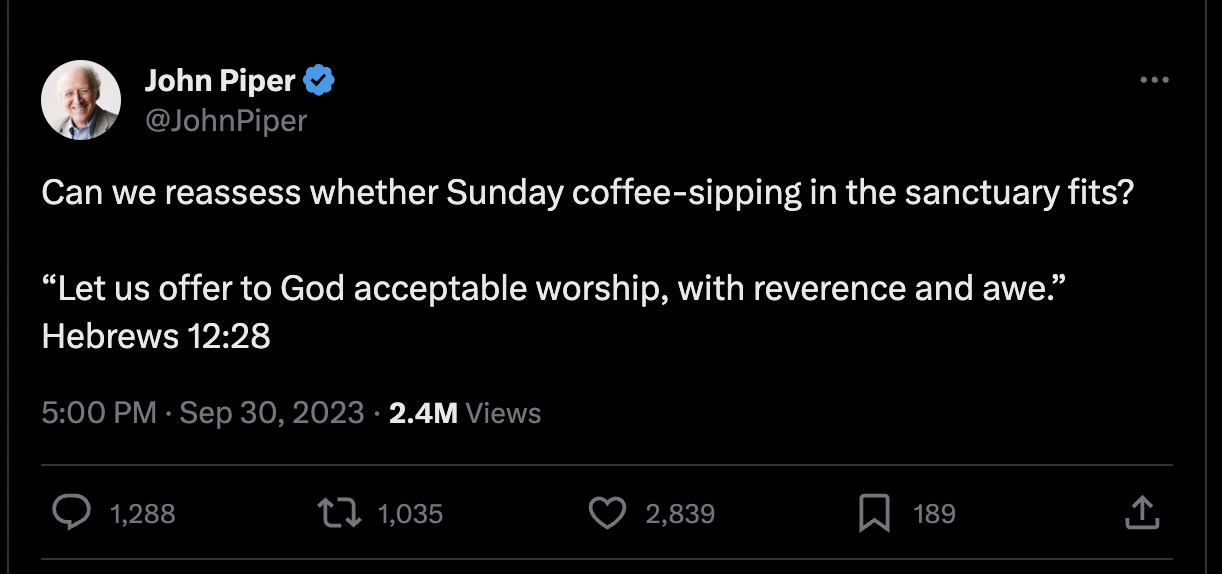
The week’s Twitter(X) flare up came courtesy of this tweet by pastor/speaker/author John Piper:

Disclaimer 1: I greatly appreciate John Piper’s writing and speaking ministries and have grown through them.

Disclaimer 2: I am HUGE coffee fan.

Disclaimer 3: I drink coffee during worship gatherings. I’ve even been known to eat on occasion.

OK. With those important caveats out of the way, I can certainly understand why people responded the way they did to Piper’s tweet. Many saw an opportunity for a little fun and took advantage of it (I posted this tweet and this tweet in this spirit). Some appreciated Piper for asking the question and prompting introspection. Others saw this as permission to disparage coffee-drinking in worship gatherings. And still others took offense at Piper’s question and what they believe was implied legalism.

A Few General Thoughts

I won’t pretend to know Piper’s thinking, but it strikes me as an odd tweet from him. After all, this is the same guy who wrote an incredibly helpful piece called “How to Drink Orange Juice to the Glory of God.” While the subject of that article isn’t worship precisely, it’s about how we can drink orange juice to God’s glory by doing so with gratitude. That’s at least adjacent to worship. If we can drink orange juice with gratitude as a means of thanking God for His provision and proclaiming His glory, it sure seems reasonable to me that we can do those things in a worship gathering, even with a coffee in hand.

The second thing I found interesting about Piper’s tweet was his quote of Hebrews 12:28. Again, Piper didn’t expand on this tweet to my knowledge, so we have to guess at his intention, but it seems as if he was (a) suggesting coffee drinking hinders reverence and awe and (b) assuming “worship” in this verse must be a corporate worship gathering. I’m not sure a strong case can be made for either of those.

But even if we were to see Hebrews 12:28 as speaking to corporate worship, that leads to another problem with what Piper seemed to be saying. The early church, after all, would gather and eat full meals as part of the Lord’s Supper, what many see as the most holy act of worship we can offer. So basically, the inference is that for the early church:

Eating + Lord’s Supper = Worship

but that for the modern church:

Coffee + Preaching/Singing ≠ Worship

A third thing I found curious was the singling out of coffee drinking, or “coffee-sipping” as Piper called it (a term that seems curiously inflammatory, but that could just be me). Why not water drinking? Gum chewing? Mint sucking? Why not phone scrolling? Bulletin reading? People watching? Where is the line drawn?

My Two Cents

To me, unless something is distracting others (e.g., setting up an omelet station in the third pew) or is done with the wrong heart, we need to give a wide berth here. This is an issue of individual conscience first, and the desires of a local congregation second. If someone sees coffee drinking as inappropriate for worship, then he or she should not drink it. If a congregation agrees to that and wants to disallow coffee drinking in their gatherings, that’s their freedom in Christ. But once we step into judging whether coffee drinking is or is not conducive to reverence and awe for all believers, we have pressed too far. How those are defined and how “worship” is defined isn’t clear to me.

Furthermore, it’s instructive that Jesus spoke of eating the Lord’s Supper with Him in the kingdom (Mark 14:25), and feasting and worship, even in heaven, are paired in the Bible quite often (Ps. 23:5; Is. 25:6; Luke 13:29; 14:15, Luke 22:19; Rev. 19:6–9). So basically the inference is:

Eating with Christ in Eternity = Reverent

But:

Coffee Drinking in Worship Reverent

I’m sure this isn’t anyone’s intent, but it sure seems that contemporary worship gatherings are held in higher regard than being in Christ’s presence.

Two Implications for Kids and Student Ministries

So, what does this have to do with anyone in kids or student ministry? Here are two takeaways:

First, how might this thinking of “worship,” “reverence”, and “awe” by some in the church—including perhaps on a ministry team—affect your worship times? It’s quite likely that kids and students will eat and drink things (e.g., goldfish given as a mid-service snack), wear things (e.g., hats and shorts), and do things (e.g., play games on stage, dance) that others would find troubling if they saw them. Even if no one has ever shared concerns, it would be wise to be ready with an answer to any objection raised. We should be ready when someone asks, “Can we reassess whether Sunday goldfish eating in kids worship fits?”

Second, to the point Piper seemed to want to make, it should indeed prompt us to consider why we do all we do. Are there any ways that we might “cheapen” worship of God? Do we ever do anything with a utilitarian mindset rather than one that seeks to glorify God? I see a lot of gray areas here. I think there are more questions than answers. But it’s an ongoing conversation ministries should have.

“Thriving in Babylon” Sermon

TLDR: At the Kidzmatter 2023 Conference, I shared for a few minutes about the posture we need to take with our upside-down culture. Here, Larry Osborne takes more time to say it better than I can.

What a privilege it was to share with the Kidzmatter Conference attendees from the main stage and talk about a subject that is dear to me: how to engage a culture that seems to be losing its mind. I have a heavy heart in how I see so many of my brothers and sisters in Christ take a combative approach. I just cannot see the love or the biblical warrant to throw “holy haymakers” at the lost. I didn’t see Jesus do that. Why should we?

In my brief message, I drew from 1 Corinthians 16:13–14.

13 Stay alert, stand firm in the faith, show courage, be strong. 14 Everything you do should be done in love.

NET1

From this, we can heed Paul’s admonishment to stand firm together on the gospel of Jesus Christ. We need to stop dividing ourselves and attacking each other because we disagree on secondary or tertiary issues, or worse, because we differ on non-theological issues. We need to stand as one bride of Christ.

But what of our arms and hands? I see the answer in v. 14. We must refuse to ball our hands into fists; we need to keep our hands open with our arms open wide, beckoning our culture to come to Christ. Come to the truth. Stand with us on the gospel.

I have known what I was going to share for some time, but in an act of God’s kind providence, our church began a new series on how to engage with the culture this past Sunday. As I sat listening to our guest Larry Osborne (author of Sticky Teams, one of my recommended reading books) preach that morning at New Vision , I couldn’t help but think I should change my text to Daniel 1. But alas, I wouldn’t have enough time to flesh this chapter out, and I knew I could just post the video anyway. Plus, I learned a long time ago (a) to trust the Holy Spirit and (b) never to imitate someone else’s preaching.

So, friends, I want to encourage you to take some time and listen to Larry Osborne do a wonderful job of showing four principles of how we are to engage with our culture drawn out from Daniel. It’s a message that is unashamed of the gospel but one that’s also saturated with compassion and kindness.

  1. NET Bible® copyright ©1996-2017 by Biblical Studies Press, L.L.C. ↩︎

2023 Kidzmatter Conference

Here are overviews and the slide decks for the two breakouts I led (along with my wife on the second) at the 2023 Kidzmatter Conference in Murfreesboro, Tennessee. If you were able to attend, I hope you found them helpful.

Leading from Who You Are

How to Discover, Appreciate, and Lead from Your Unique Ministry Wiring

Ministry leaders are not one-size-fits-all, interchangeable, cookie-cutter leaders. God has equipped, gifted, and wired you in a way that is different from every other leader—and that’s a good thing! The key, then, is to understand how God has wired you and to lead in a way that is true to your wiring instead of trying to imitate someone else’s wiring. In this breakout, we will explore various aspects of ministry leadership to help each of us do just that.

Not Just Safe for Kids

How to Look for and Prevent Spiritual Abuse in Your Ministry and Church

We often talk about how to keep kids safe in our ministries, and rightly so. But what about our safety as ministry leaders and the safety of our team members in a day when we are hearing more and more of spiritual abuse? In this breakout, you will hear from Brian, who served in church ministry for seventeen years, and his wife, Tara, a Mental Health Therapist who holds an MA in Clinical Mental Health Counseling and is a National Certified Counselor, as they share signs of spiritual abuse, the reasons spiritual abuse is so harmful, and steps you can take to ensure your ministry is saturated with love, compassion, care, and grace.

New Family Discipleship Book with InterVarsity Press

TLDR: Look for my newest book published by IVP soon that suggests a better way for families to disciple our kids in the home.

credit: pixabay.com

I intended to earn a Ph.D. in theology at Midwestern Baptist Theological Seminary. God was kind enough to have a better plan. When I was told that if I pursued a Ph.D. in ministry instead, I’d be halfway done because of my D.Min., it didn’t take much convincing. So I signed up.

When it came to thinking about a dissertation topic, I knew I wanted to do something about family discipleship. I wasn’t sure exactly what though. My initial research question that got the ball rolling was whether Sunday school had steamrolled discipleship in the American home when that ministry began in the late 1700s. My thinking was that we could see where things went wrong back then and course correct if that was indeed what happened, or learn long-forgotten lessons about how the church and home are supposed to work together in discipling kids if that was prioritized then.

A Shocking Discovery

As I began researching, I wasn’t finding much of an answer to that question, but I started noticing some other fascinating patterns—namely that the battle between the church and home goes way back farther than we might think. I started to see quote after quote through the generations saying what is said today: parents are failing to disciple in the home. It became evident that there has never been a generation of parents in America who discipled in the home well. Never. Not even the Puritans.

So that discovery shifted my dissertation in a different direction. If we’ve never discipled well, then we need a new approach. An approach that is faithful to the Scriptures, but that doesn’t try to reinvent the wheel—a wheel that has been wobbly at best all along anyway.

Finding the Right Keys

As I continued exploring family discipleship throughout American history and evaluating family discipleship books and resources, a few notable “keys” to family discipleship rose to the surface.

First, one area that is often lacking in discipleship is identity. We talk a lot about the gospel (and rightly so) and quite a bit about behavior (although often through the wrong lens), but rarely do we focus on identity. At best, it’s a side note. But it’s a major part of the gospel.

Second, in light of identity, almost no mention is made of what it means that we are made in God’s image and, when we trust in Jesus, we are made new in him. In Christ is foundational to Paul’s theology, as it should be for us too.

Third, while behavior is often covered, it is rarely, if ever, addressed through the lens of imitating Jesus, the perfect image of God. While the dots of Jesus and our behavior are often noticed, they are rarely connected, at least not clearly.

Putting it All Together

My connective thread of these big ideas was borrowed from a different field of theology and ministry—from seeing the Bible as a drama. In the second half of the twentieth century, a small group of theologians began exploring the idea of what has been called the theodrama, that the Bible is a depiction of God’s actions with the intention of us continuing on as actors ourselves.

So, what’s in store in this book? The suggestion that we disciple our kids through that dramatic lens—seeing Scripture as a “script” of sorts that we use to learn the role God has given us to play as his image-bearers by looking at the perfect image of God, Jesus. We look to Jesus first for salvation, of course, but then for how we are to live day-in and day-out. We look to Jesus to see what a perfect human is to live like and then we imitate him through improvising his perfect human character traits (e.g., love and humility) in our unique setting. Our discipleship begins with that goal in mind—that we are helping coach our kids of what their daily living should look like.

That dissertation and this book have been a labor of deep love for me. I am praying that God uses this new book to encourage and equip parents to be the first generation in American history who thrived in this critical ministry.

I’m not sure when this book is slated to release, but look for it perhaps in late 2024 or early 2025. I’ll keep you posted.

Kids Ministry Reading List

TLDR: A list of books to consider reading if you’re in kids ministry.

UPDATED: 1-18-25

There are a lot of great books for Kids Ministry leaders to read. Then, there are some not-so-great ones too. Below is a list of books to consider whether you’re new in ministry or a seasoned veteran. Not all are about kids ministry specifically, but they certainly apply. Some aren’t even directly ministry-related, but I believe they surely connect. Some, like Who Am I?, Created in God’s Image, and Who God Says You Are are included because ministry leaders need to have our identities properly grounded.

If you have any suggestions for books to add, I’d love to hear from you.

Book cover images come from Amazon.com.

LEADER DEVELOPMENT

Barton, Ruth Haley. Strengthening the Soul of Your Leadership: Seeking God in the Crucible of Ministry. Downers Grove, IL: InterVarsity Press, 2018.

While many leadership books focus on character and even more on competency, this is one that that focuses on the soul. Or, to put it another way, this book is not written primarily for the head or hands, but rather for the heart. Each chapter includes a spiritual practice to move what you read deeper within.

Bonem, Mike and Roger Patterson. Leading from the Second Chair: Serving Your Church, Fulfilling Your Role, and Realizing Your Dreams. Fortress Press ed. Minneapolis, MN: Fortress Press, 2020.

I’m not sure if there is a single kids ministry leader or even a family ministry leader who is the leader in a church. Rather, the position is almost always in a “second chair,” if not often in a third, fourth, or fifth one. As such, being comfortable and content in your role, building healthy relationships with your leader or leaders, and learning how to “lead up” are critical skills.

Bridges, Jerry. Who Am I? Identity In Christ. Adelphi, MD: Cruciform Press, 2012.

One common trap that ministry leaders fall into is placing their identity in their ministry role. They see themselves primarily as a “kids pastor” or “family pastor” often even beyond “wife/husband,” “mother/father,” and even child of God. Books like this one will not connect directly to ministry, but they are critical to keep you grounded in who you truly are.

Elmore, Tim, and Andrew McPeak. Marching Off the Map: Inspire Students to Navigate a Brand New World. Atlanta, GA: Poet Gardener Publishing, 2017.

While this book targets what students face more than kids, we know that (a) things are accelerating meaning what students faced in 2017 when this was written is likely on our kids’ radars today and (b) when it comes to technology especially, our kids are surely oversaturated. This is a book that will help us find ways we should consider adapting to connect better with kids today who are very unlike kids even ten years ago.

Greear, J.D. Gospel: Recovering the Power that Made Christianity Revolutionary. Nashville, TN: B&H Publishing, 2011.

This book has nothing to do with kids ministry and family ministry, and yet it has everything to do with kids ministry and family ministry. If we are going to build our ministries on the gospel and teach our kids the gospel, we need to be sure we know what that gospel is. In some ways, this word has lost meaning because of overuse. This is a book that will help you remember what it truly is all about.

Gawande, Atul. The Checklist Manifesto: How to Get Things Right. New York, NY: Metropolitan Books, 2009.

Not only is this not a kids ministry book, it’s not a ministry book at all. It’s a “business” book, but it’s one that every leader should read. Most kids ministry leaders tend to be uber organized, so many will read this less to learn from and more to affirm their wiring. But there will still be ways to grow from it. And for those who struggle with organization, buy this today.

Hoekema, Anthony A. Created in God’s Image. Grand Rapids, MI: William B. Eerdmans Publishing Company, 1994.

This is another book that doesn’t address kids ministry or ministry directly, but needs to be read to keep us grounded. This is the best book I have read on what it means to be made in God’s image.

Kruger, Melissa, ed. Identity Theft: Reclaiming the Truth of Our Identity in Christ. Deerfield, IL: The Gospel Coalition, 2018.

This is a book written by women and the intended audience is women. But it shouldn’t be. This is a fantastic and important book for all believers. Add this to the list of books that speak more to the leader himself or herself and not to ministry. This one explores ways we lose sight of our identity.

Rosner, Brian S. Known by God: A Biblical Theology of Personal Identity. Grand Rapids, MI: Zondervan Academic, 2017.

Yet another book that concerns who we are as followers of Christ rather than speaking to kids ministry. Seeing a pattern? Can you tell what I think is most vital for a flourishing ministry? What I love about this book is that in it we chase down a beautiful but oft neglected truth of being known by God. Knowing God is amazing for sure. But being known by God is even more incredible.

Sanders, J. Oswald. Spiritual Leadership: Principles of Excellence for Every Believer. Chicago, IL: Moody Publishers, 2007.

If you could only read one book on leadership, this should be it. This book focuses on the character of the leader and is packed with wisdom. I know of people who read this annually. It’s not a bad idea.

Smith, Christian, and Melinda Lundquist Denton. Soul Searching: The Religious and Spiritual Lives of American Teenagers. New York, NY: Oxford University Press, 2005.

The data about the spiritual condition of teens may be dated, but this is still a must-read. In fact, the data is worse now, so the startling conclusions then are even more sobering today. This book is also where the term “moralistic therapeutic deism” was coined.

Snodgrass, Klyne R. Who God Says You Are: A Christian Understanding of Identity. Grand Rapids, MI: Eerdmans, 2018.

Another outstanding book on finding our identity in Christ. Once again, if we do this and build our lives and ministries on that core identity, we will serve more faithfully, more joyfully, and more meaningfully.

Tripp, Paul David. Lead: 12 Gospel Principles for Leadership in the Church. Wheaton, IL: Crossway, 2020.

If Spiritual Leadership didn’t exist, this would be the best ministry leadership book out there. Like Sanders’ book, this one focuses on the character of the leader.

MINISTRY AND ORGANIZATIONAL PHILOSOPHY

Adams, Steve. Children’s Ministry on Purpose: A Purpose Driven Approach to Lead Kids toward Spiritual Health. Grand Rapids, MI: Zondervan, 2017.

This is a strong book to add to a leader’s collection. Notice what I said there. This is best read as one among several books that advocate for a certain philosophy/structure of ministry. It’s not that this one has problems, it’s just that ministry is not one-size-fits-all. So one huge mistake to avoid is reading one book, taking it as gospel, and then implementing it without question or at least adaptation. My suggestion is get several books that advocate various positions and “Frankenstein” your own ministry.

Bell, Valerie, et al. Resilient: Child Discipleship and the Fearless Future of the Church. Marceline, MO: Walsworth Publishing Company, 2020.

The premise here is simple, but critically important: we cannot do ministry today like we have always done it. Indeed, one of the mistakes we often make is we fail to disciple our kids in our ministries. We do a host of other things, but we don’t disciple. This book advocates that we build our ministries on the 3 B’s: Belonging, Believing, and Becoming. How you do it might take different forms, but those three elements must be present in a ministry that truly disciples kids.

Cimo, Pat and Matt Markins. Leading KidMin: How to Drive Real Change in Children’s Ministry. Chicago, IL: Moody, 2016.

This book provides practical wisdom in various topics within kids ministry, including how to cast vision, how to align with the larger church and work with a lead pastor, and how to discover your leadership approach.

Collins, Jim. Good to Great: Why Some Companies Make the Leap…and Others Don’t. New York, NY: HarperBusiness, 2001.

It might seem odd of me to consider a book like this a must-read in kids ministry, but if you’ve ever read it, you likely know why. This. is a business book through and through. But there is gold to mine in it that we can apply to our ministries and leadership. The “Stockdale Paradox” alone is worth the read.

Dembowczyk, Brian. Gospel Centered Kids Ministry: How the Gospel Will Transform Your Kids, Your Church, Your Community, and the World. Nashville, TN: B&H Publishing, 2018.

Call me a homer. OK. But I wrote this book to help ministries and I believe it does that. One criticism I’ve heard about it is that it doesn’t get practical enough. Fair. My hope though is that it sparks thinking and provides at least a map for leaders to find their own path toward application in their context.

DeVries, Mark and Annette Safstrom. Sustainable Children’s Ministry: From Last-Minute Scrambling to Long-Term Solutions. Downers Grove, IL: InterVarsity Press, 2018.

This is a good partner book with Children’s Ministry on Purpose. Like that one, this one cannot stand alone. It presents a solid approach to ministry, but it. is just one approach with pros and cons.

Frank, Ryan. The KidzMatter Playbook. Marion, IN: KidzMatter Publishing, 2025.

The KidzMatter Playbook reads like the Book of Proverbs; it isn’t a long read, but it’s packed with nuggets of practical wisdom for ministry. In it, three foundations of a healthy and growing ministry are shared: (1) A Healthy Leader, (2) A Passionate Team, and (3) Robust Systems.

Hamilton Jr., James M. What Is Biblical Theology: A Guide to the Bible’s Story, Symbolism, and Patterns. Wheaton, IL: Crossway Books, 2014.

The Bible tells one story of God’s plan of redemption through Jesus Christ. If we’re going to teach kids the Bible accordingly, then we need to really understand this story arc the best we can. This is a wonderful book to help you do just that and thus build your ministry on the gospel story.

Joiner, Reggie. Think Orange: Imagine the Impact When Churches and Families Collide. Colorado Springs, CO: David C. Cook, 2009.

“And.” That’s the core message of this book. We need to see how God has teamed together the church and the home. It’s not either-or. It’s both-and. Just as yellow and red make orange, the church and home working together is God’s design for discipling the next generation.

Jones, Timothy Paul, ed. Perspectives on Family Ministry: 3 Views. Nashville, TN: B&H Academic, 2009.

Few would say that churches shouldn’t minister to families. But how we do that is debated. Should we keep families together? Should we focus on training parents? Should we focus on discipling kids? I love these perspective books because they let advocates make their own case and then address concerns of the other positions.

Keeley, Robert J., and Mimi L. Larson, eds. Bridging Theory and Practice in Children’s Spirituality: New Directions for Education, Ministry, and Discipleship. Grand Rapids, MI: Zondervan, 2020.

This is the most academic of books on the list, but don’t let that either intimidate you or drive you away. This book explores some important issues. Not every chapter will relate to you and your context, so skip those. It’s still worth it for. the ones left.

Kennedy, Jared. Keeping Your Children’s Ministry On Mission. Wheaten, IL: Crossway, 2022.

In “Keeping Your Children’s Ministry On Mission,” Jared Kennedy does a marvelous job of providing keen theological teaching as it relates to children’s ministry alongside practical wisdom. As it is, this book will reach up highly and spend time in the philosophical sphere of ministry, but it does that without missing practical everyday application. This is an important book for those who, like the title suggests, are in more of a maintenance mode, but it is also a book that anyone starting a kids’ ministry or needing to overhaul a kids’ ministry needs to read.

Lencioni, Patrick. The Five Dysfunctions of a Team: A Leadership Fable. San Francisco, CA: Jossey-Bass, 2002.

You are likely part of two teams—your church leadership team and your ministry team. This book will help with both of those. This is another book that is not a ministry one, but rather a business one, but like the others on the list, there’s ample room for connecting it to your ministry.

Luce, Samuel and Hunter Williams. How to Teach Kids Theology: Deep Truths for Growing Faith. Greensboro, NC: New Growth Press, 2025.

There are plenty of books on theology and plenty of books on how to teach kids, but far too few books on how to teach kids theology. Sam and Hunter provide an important resource to help fill this void. Practical, accessible, and weighty, How to Teach Kids Theology will be a great help to the church and home.

Markins, Matt, Mike Handler, and Sam Luce. Forming Faith: Discipling the Next Generation in a Post-Christian Culture. Chicago, IL: Moody, 2024.

The core idea of Forming Faith is that far too many churches and homes are trying to disciple children in the wrong ways—indeed, many are failing to disciple all together. Backed by statistics and years of experience and guided by Scripture and wisdom, this is an important read for ministry leaders to help them consider not just what we do, but why we do it.

Miller, Vincent J. Consuming Religion: Christian Faith and Practice in a Consumer Culture. New York, NY: Continuum, 2005.

OK. This one could be just as academic as Bridging Theory, but it too is well worth the read. In this book, consumerism is explored in light of church. Not only will this give you help in looking out for this pattern in your kids, but it will also help you think about how you lead your ministry. We could be feeding this without realizing it.

Osborne, Larry. Sticky Teams: Keeping Your Leadership Team and Staff on the Same Page. Grand Rapids, MI: Zondervan, 2010.

If you could only read one book on teams, let it be this one. This book is written more for a lead pastor and some of. the topics might not relate as readily for that reason, but what can be directly applied or adapted to apply is some of the best wisdom on leading teams out there.

Peters, Chuck, Jana Magruder, and Stephanie Salvatore. Flip the Script: Disrupting Tradition for the Sake of the Next Generation. Nashville, TN: Lifeway Press, 2022.

This is another stat-driven book looking to help us consider why we do what we do but also how we are best to do it. My three friends do a great job of sharing how we cannot change the gospel we teach, but we need to be able and willing to change how we teach it.

Postman, Neil. The Disappearance of Childhood. New York, NY: Vintage Books, 2011.

This book was first released in 1996, but it is still a timely read. One of my discoveries that I made during my PhD. dissertation research was that childhood as we know it hasn’t always existed. The concept of childhood has changed and ebbed and flowed throughout history. It seems that we are watching it decline before our eyes. While this may seem like an odd inclusion for a ministry reading list, we need to understand how our culture sees kids, how our parents see kids, and how our kids seem themselves if we are going to minister to them.

Reju, Deepak and Marty Machowski. Build on Jesus. Greensboro, NC: New Growth Press, 2021.

This is a great book for new kids ministry leaders because it covers so many of the basics of ministry. But it’s also a great book for seasoned kids ministry leaders who need to brush up or who want to ensure they have well-designed holistic ministries.

Ripley, Jennifer S., James N. Sells, and Diane J. Chandler. Ministering to Families in Crisis: The Essential Guide for Nurturing Mental and Emotional Health. Chicago, IL: InterVarsity Press, 2024.

I wish we didn’t need Ministering to Families in Crisis, but I’m sure glad we have it. The difficult truth is that many of the families we serve are indeed hurting and in crisis. The problem is that many of us haven’t been trained how to respond. Instead, we often feel afraid or paralyzed, wanting to help but not knowing how. Ministering to Families in Crisis provides the theologically robust and practical guidance we need to love and care for our families.

Stinson, Randy, and Timothy Paul Jones, eds. Trained in the Fear of God: Family Ministry in Theological, Historical, and Practical Perspective. Grand Rapids, MI: Kregel Academic & Professional, 2011.

Like Bridging Theory, not every chapter of this book might connect with you. But there is plenty of “meat” in this book to sink your teeth into, even if you leave some scraps on the plate.

Wishy, Bernard W. The Child and the Republic: The Dawn of Modern American Child Nurture. Philadelphia, PA: University of Pennsylvania Press, 1967.

This is another fascinating book that looks how the concept of childhood developed and has changed. Like a couple others on this list, this book will not relate directly to a kids ministry, but it is extremely beneficial to know how childhood as we see it has not always existed. And in time, childhood as we know it right now will be no more. The changes might seem slow, but they’re actually happening at a faster pace than we might realize. This book is out of print as far as I know, so if you are able to snap one up, do so.