TLDR: A guide for having a family discipleship time on Genesis 25 based on the ACT Bible Study Method.
Act 3: God Promises Jesus
Scene 13: Jacob Takes the Family Birthright
Genesis 25:19–34
Analyze the Passage
Step 1: Introduce the Passage
Genesis was written by Moses sometime between 1445–1405 BC to help the Israelites leaving Egypt understand their history with God. It’s one of the five books of the Law that Moses wrote, which we also call the Torah, or the Pentateuch, which means “five books.”
Today’s true story is one that introduces us to Jacob, Isaac’s son and the one who would become the father of the twelve tribes of Israel. This story is in Act 3: God Promises Jesus.
Step 2: Read the Passage
Step 3: Summarize the Passage
When Isaac was 40 years old, he married Rebekah, who couldn’t have children. But Isaac prayed for Rebekah and she became pregnant. She had twins in her womb, and they struggled with each other. When she asked God why, he said it was because they were two separate nations, one would be stronger, and the older would serve the younger.
The first boy born was Esau, he was reddish and hairy. The second boy was Jacob; he came out holding Esau’s heel.
When they were grown, Esau became a hunter and Jacob lived in the tents. Isaac loved Esau more; Rebekah loved Jacob more.
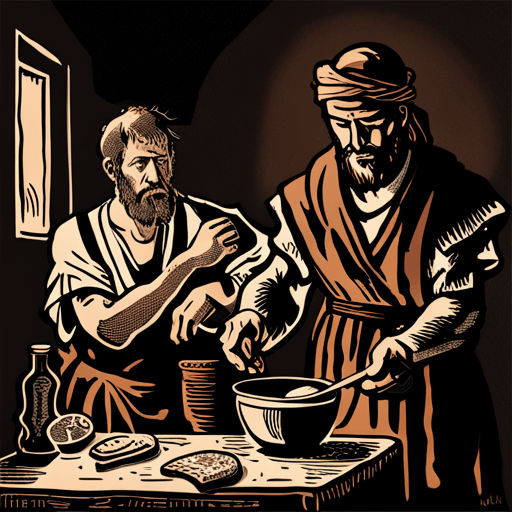
One day, Jacob made some stew while Esau was in the fields. Esau came in starving and asked for some stew. But Jacob made him sell his birthright for it. Esau said because he was about to die from hunger, he may as well and agreed.
Step 4: Interrogate the Passage
Questions you and your family ask might include:
- Why did so many women have trouble having children in Genesis?
- How did Rebekah hear from the Lord?
- What did God mean by the children being two nations?
- What did it mean that Jacob lived in tents?
- Why didn’t Jacob just give his hungry brother some stew?
- What is a birthright?
- Did Esau really think he was about to die?
- What does it mean that Esau despised his birthright?
Step 5: Wonder about the Passage
Wonder statements you and your family make might include:
- I wonder how long Isaac prayed for Rebekah.
- I wonder what the children struggling in her womb felt like.
- I wonder why the older would serve the younger.
- I wonder what Esau looked like all reddish.
- I wonder if everyone knew Isaac and Rebekah had favorites.
- I wonder if the stew as good enough to be worth it to Esau.
Connect the Passage to Christ
Step 6: Find the World in Front of Text
This passage shows us more of how the world shouldn’t be. While we see Isaac praying for Rebekah and Rebekah going to God to try to make sense of things, beyond that, we more see how this family wasn’t living as God designed for families to be.
First, we see the twins struggling in the womb, and while we cannot be sure what that means, we know this was a picture of how their relationship would be pretty much their entire lives.
We also see favoritism in this family—a pattern that began with Abraham and Sarah and will continue through Jacob and his wives and children. Favoritism, as we will see, is hurtful and harmful. God calls on us to love others instead.
Finally, we see Jacob taking advantage of a situation to exploit his brother. Instead of loving his brother and being glad to give him food, he made him trade something of great value—an extra portion of the family inheritance—for a single meal.
Step 7: Find the World of Jesus of the Text
As we focus especially on Jacob and Esau’s interaction, we see that Jacob lacked compassion and generosity. He failed to lovingly care for his brother when he was in need. And he failed to give to Esau freely and generously. Instead, he leveraged the situation to get something he wanted from Esau.
Jesus, of course, shows us a different picture, a better picture, of what it looks like to live with compassion and generosity for others. Jesus cared for others during his time on earth and provided what they needed without cost. He was generous with all he had, even giving up his life for us.
Translate It to Your Context
Step 8: Connect the World of Jesus of the Text to Your World
How can you show others compassion this week? How can not only care about others, but act on that care by doing whatever you can for them, especially if they are in need. What can you do with your time, money, and possessions to help others in need?
How can you be amazingly generous with someone this week to show them Jesus? Who might you be generous toward, how might you do it, and when might you do it?
NEXT: Act 3: God Promises Jesus; Scene 14: Jacob Steals Esau’s Blessing (Genesis 27:1—28:9)
Learn more about this family discipleship method here.
 brian dembowczyk